
 Available in US
Content

The first time someone explained a betting exchange to me, the idea that I could be the bookmaker rather than the punter felt slightly illicit, like being handed the keys to the other side of the counter. That’s essentially what an exchange does. It removes the house from the middle and lets ordinary bettors take each other’s bets, which changes the economics of cricket betting more profoundly than any clever staking system ever could.
A betting exchange is a marketplace, not a bookmaker. Instead of pricing a market and taking your bet against the house, the exchange matches you against other punters: one person backs a selection, another lays it, and the exchange simply pairs them and takes a small commission on net winnings. There’s no bookmaker margin baked into the odds, because there’s no bookmaker, and that single structural difference is why exchanges have become indispensable to serious cricket bettors.
How an Exchange Matches Bets
Picture a market stall where buyers and sellers shout prices until they agree, and you’ve basically got an exchange. One person is willing to back England at 2.10; another is willing to lay them at 2.10; the exchange matches the two and the bet is struck. Nobody set that price as a “house view”. It emerged from what people were actually prepared to take and offer, which is a fundamentally different way of arriving at odds.

The mechanism runs on an order book exactly like a financial market. You can see the prices available to back and to lay, and the amounts of money queued at each, and you either take a price that’s already on offer or post your own and wait for someone to match it. If you ask for a price better than the market’s currently offering, your bet sits unmatched until someone meets it or the market drifts your way. That’s a genuine adjustment for anyone used to a bookmaker, where the price is simply handed to you and matched instantly; on an exchange you sometimes have to be patient, and occasionally your bet never gets matched at all.

What makes this work is liquidity, the amount of money active in a market, and cricket’s liquidity is concentrated on the big events. A high-profile international has deep, fast-moving exchange markets where you can get substantial sums matched in seconds; an obscure county match might have so little money that the prices are wide and your bet sits unmatched for an age. The global cricket betting market, worth around 76.5 billion US dollars in 2023 and forecast past 151 billion by 2032, sounds vast, but that money pools around the marquee fixtures, so the exchange experience swings from seamless on a Test to frustrating on a minor game.
Backing Against Laying in Cricket
The concept that genuinely changes how you bet is laying, and it’s worth slowing down over because it flips the entire logic of a wager. To lay a selection is to bet that it won’t happen, taking on the role the bookmaker normally plays. Lay England to win and you’re effectively the house: you collect the backer’s stake if England lose or the match is drawn, and you pay out if they win.
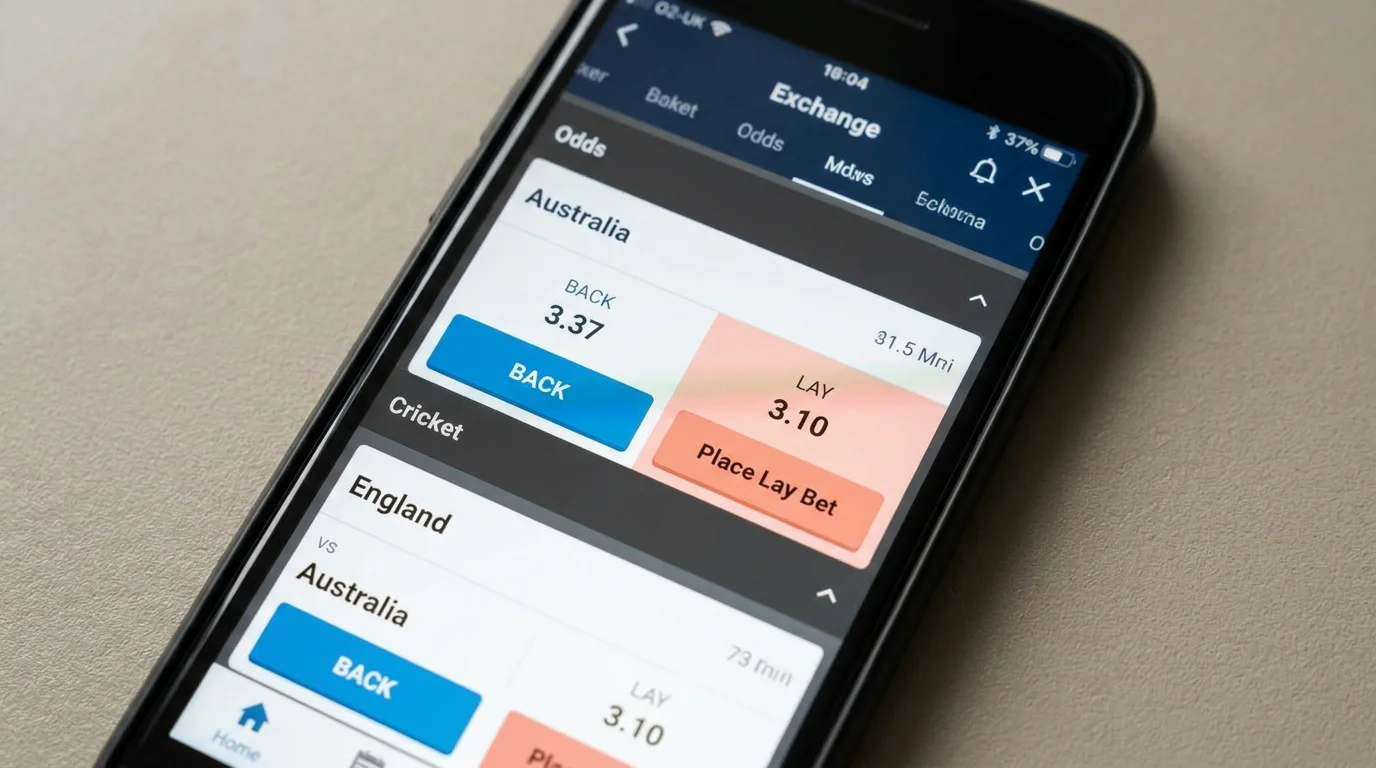
This opens up bets that simply don’t exist with a traditional bookmaker. Convinced a heavily backed favourite is overrated? You don’t have to back the field against them; you can lay them directly, and profit if they fail to win. Spotted a team whose price has been driven artificially short by sentimental money? Lay them and let the correction pay you. Laying lets you express negative opinions, the “this won’t happen” views that are often easier to hold with confidence than positive predictions, and it’s the single biggest reason serious cricket bettors gravitate to exchanges.
The responsibility that comes with laying is understanding your liability, which works backwards from a normal bet. When you back at 5.00, you risk your stake to win four times it. When you lay at 5.00, you do the opposite: you stand to win the backer’s stake but you’re liable for four times it if the selection wins. Laying a long-priced outsider therefore exposes you to a large potential loss for a small potential gain, the mirror image of backing one. I’ve seen newcomers lay a big-priced selection thinking they’d “win easily” and not grasp that a single unlikely result could cost them many times their apparent stake. Laying is a tool, not a free lunch, and the liability maths deserves the same respect as any other risk.
Commission Against the Bookmaker’s Margin
Here’s the question that decides whether the exchange is worth it for you: is the commission cheaper than the margin you’d pay a bookmaker? For most liquid cricket markets, the answer is a clear yes, and understanding why is the final piece of the exchange picture.

An exchange doesn’t shade the odds. It charges a commission, typically a small percentage, on your net winnings in a market, and only when you win. Compare that to a traditional bookmaker, where the cost is invisibly built into every price as the overround, charged whether you win or lose because it’s baked into the odds themselves. On a competitive market the bookmaker’s margin might run to a few per cent on every bet, while the exchange commission applies only to your net profit, which on most accounts works out cheaper, especially for a bettor who turns over a lot or who hunts for keen prices. The full anatomy of that built-in bookmaker cost, and how to measure it on any market, is in my guide to bookmaker margin in cricket odds, and reading the two side by side makes the exchange’s cost advantage obvious.

The advantage isn’t universal, and honesty demands the caveats. On thin markets, the exchange’s lack of liquidity can mean worse available prices than a bookmaker would offer, wiping out the commission saving. The exchange also won’t shower you with the free bets and promotions that bookmakers use to attract custom, so a casual punter chasing offers might find the traditional route more rewarding. And laying carries the liability risk we’ve discussed, which a backing-only bookmaker account avoids entirely. The exchange suits the bettor who values keen pricing, the ability to lay, and the chance to trade in and out of positions over the bettor who wants simplicity and sign-up bonuses.
For me, the exchange is where the serious cricket betting happens, because the absence of margin and the power to lay together amount to a structural edge that no amount of clever selection can replicate on a bookmaker’s terms. But it rewards understanding, not enthusiasm. Learn how matching and liquidity behave, respect the liability that laying brings, and weigh the commission honestly against the margin you’d otherwise pay, and the exchange becomes the most powerful platform in cricket betting. Treat it casually, and the laying liability and thin-market prices will teach you the same lessons the hard way.
What does laying a team in cricket actually mean?
Laying a team means betting that it will not win, taking on the role a bookmaker normally plays. You collect the backer’s stake if the team loses or the match is drawn, and you pay out if it wins. Your liability is the backer’s stake multiplied by the odds, so laying a long-priced selection carries a large potential loss.
Is exchange commission cheaper than a bookmaker margin?
On liquid cricket markets, usually yes. Commission is a small percentage charged only on your net winnings, whereas a bookmaker’s margin is built into every price and paid whether you win or lose. On thin markets, though, poor exchange liquidity can offer worse prices and erode that advantage.
