
 Available in US
Content
- The Result Markets, Where Everyone Starts and Many Stay
- Player Markets and the Seduction of Backing a Name
- Runs, Totals and the Markets That Reward Reading Conditions
- In-Game and Micro-Markets, the Double-Edged Sword of Live Betting
- Novelty and Prop Markets, Fun That Usually Costs You
- Matching Markets to Formats, the Skill That Ties It All Together
The first time I opened a Test match betting page and counted the markets, I gave up somewhere past forty. Match winner, top batsman for each side, total match runs, method of first dismissal, runs in the first ten overs, fall of next wicket, highest opening partnership, man of the match, series correct score, and on, and on. It was overwhelming in the way a tasting menu with eighty courses is overwhelming. The food might be excellent, but where do you even start? Seven years later I’ve eaten my way through most of that menu, and I can tell you that the abundance is a feature once you understand how it’s organised.
That’s what this guide is, a map of the territory rather than a deep dive into any single market. A cricket betting market is simply a specific question the bookmaker is offering odds on, and the modern operator offers staggeringly many of them. Who wins? How many runs? Which player scores most? Will the next ball be a wicket? Each of those is a separate market with its own prices, its own risk profile and its own logic. The job here is to give you the lay of the land, to group these markets into families so that when you face that intimidating board, you know which neighbourhood you’re standing in and which ones reward a beginner versus which ones are traps dressed as opportunities.
The reason cricket sustains this density of markets, far more than most sports, is the structure of the game itself. A match is a sequence of discrete events, ball by ball, over by over, wicket by wicket, and each of those discrete events can be priced. The regulator has noticed cricket’s rise firsthand, with the Gambling Commission’s chief executive remarking that discussions with operators show a widening of the sports on offer, with cricket named explicitly alongside basketball and a host of others growing in use beyond the traditional staples of football and horseracing. The global market reflects how lucrative this granularity is, with the worldwide cricket betting market valued at 76.5 billion dollars in 2023 and forecast to reach over 151 billion by 2032, a compound annual growth rate of 7.6%. That growth isn’t just more people betting on who wins. It’s the proliferation of ways to bet, the micro-markets and prop bets that turn a single match into hundreds of separate wagering opportunities. Understanding the families of markets is how you navigate that without drowning.
The Result Markets, Where Everyone Starts and Many Stay
If you only ever bet one type of market for the rest of your life, it would be the result markets, and you wouldn’t be wrong to do so. These are the bets on the outcome of the match itself, and they’re the cleanest, most liquid and most beginner-friendly options on any board. Everything else is an embellishment on this foundation.
The headline result market is match winner, sometimes called “to win” or “match result”. In limited-overs cricket, T20s and one-day internationals, it’s a simple two-way bet: this team or that team. There’s no draw to worry about because these formats produce a result almost every time. Test cricket complicates things by adding the draw as a genuine third outcome, which catches out newcomers constantly. A Test match-winner market has three prices, home win, away win, and the draw, and backing a team to win means precisely that, a win, not merely “not losing”. If the match peters out into a stalemate over five days, your win bet loses even though your team wasn’t beaten.

This is exactly why a cousin market exists to solve the draw problem, where your stake is returned if the match is drawn rather than lost. It strips the draw out of the equation, turning a three-way Test bet back into something closer to a two-way one, at the cost of a shorter price. It’s a hugely popular way to bet Tests precisely because the draw is such a frustrating outcome to be caught by, and the mechanics of that draw-removing variant are worth understanding before you ever bet a Test result.
Beyond the single match sit the series markets, where you back the overall winner of a multi-match contest like the Ashes or a bilateral one-day series. These outright markets reward patience and a longer view, because you’re pricing not a single game but a campaign. They also offer correct-series-score options, where you predict the exact margin, three-one, two-nil and so on, at much longer odds. Result markets, in all their forms, are where I’d point any beginner, because the question they ask is the simplest one cricket offers: who comes out on top? Master reading those before you wander into the more exotic neighbourhoods.
Player Markets and the Seduction of Backing a Name
There’s a particular thrill to backing a specific player that match markets can’t match. You’re not betting on an abstract team outcome, you’re betting on someone you can watch, a batsman you believe in, a bowler in form. I get it. I’ve felt the pull. But player markets are where confident beginners lose money fastest, and understanding why is the most useful thing I can teach you about this family.
The flagship player market is top batsman, where you back the player you think will score the most runs, either for their team or across the whole match. It sounds straightforward and it’s anything but. A cricket innings is chaotic. The best batsman in the world might be dismissed cheaply by a brilliant delivery in the first over, while a lower-order player has the day of their life. Because eleven players can bat and any of them might top-score, the prices are long and the variance enormous. Add in the influence of batting order, an opener gets more deliveries and thus more chances to accumulate, while a number seven might not bat at all, and you start to see why these markets demand real thought rather than gut feeling.
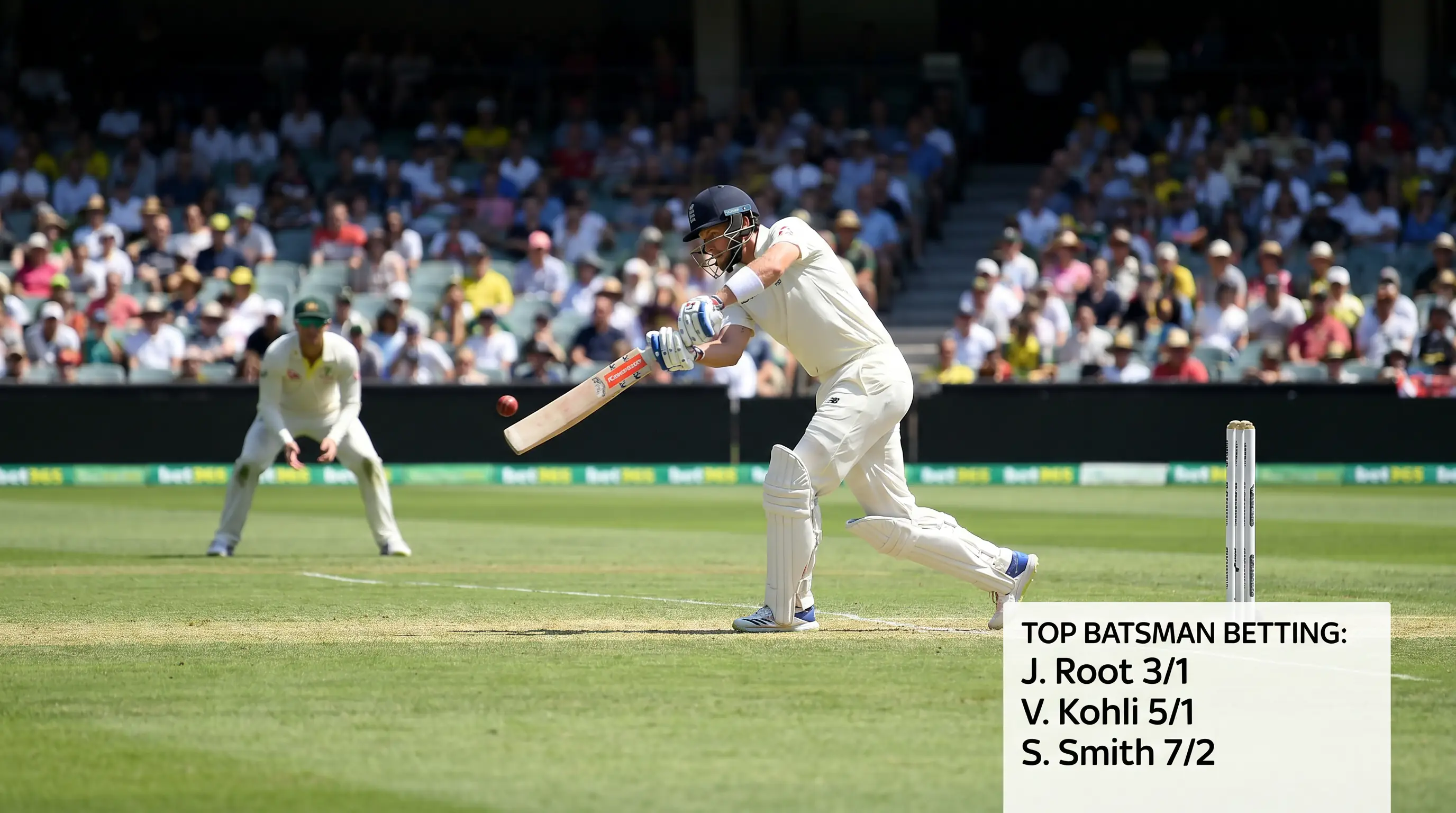
Then there’s man of the match, the award given to the standout performer, which is a market unto itself with a crucial wrinkle: it can be won by a player on the losing side, and it’s frequently claimed by all-rounders who contribute with both bat and ball. That dual-discipline value is why all-rounders are so often short-priced here, and why backing a pure specialist can leave value on the table. The settlement also hinges on a human decision, the adjudicator’s choice, which introduces a subjectivity absent from runs-based markets. It’s a fascinating market with its own strategy, distinct enough from top batsman that the two reward genuinely different reasoning.
My blunt advice on player markets is to treat them as the higher-variance plays they are. The growth in this space is real, with cricket attracting at least 165 betting sponsorship deals with teams, tournaments and players between 2020 and August 2025, 31 of those signed in just the first eight months of 2025, and that commercial intensity tells you how much money flows through player-focused engagement. But the money flowing in doesn’t make the bets easier to win. If anything, the long odds and high variance mean these markets punish overconfidence severely. Back a player because you’ve genuinely reasoned through their role and the conditions, never simply because you like watching them play.
Runs, Totals and the Markets That Reward Reading Conditions
Here’s a question I love asking newer bettors: would you rather predict who wins, or how the game flows? Most say who wins, instinctively. But the runs and totals markets, which ask the second question, are where reading conditions actually pays, and they’re often softer than the heavily-bet match-winner markets. This is the family where homework beats luck.
The core market here is total runs, an over-or-under bet on how many runs are scored, either by a team in an innings or across the whole match. The bookmaker sets a line, say 320 runs for a team’s fifty-over innings, and you bet whether the actual total finishes above or below it. What makes this rewarding is that the line is driven by conditions you can assess in advance: the pitch, the boundary sizes, the weather, the form of the batting and bowling units. A flat pitch on a small ground inflates totals. A green, seaming surface suppresses them. Reading those factors before the bookmaker fully prices them in is a genuine edge.
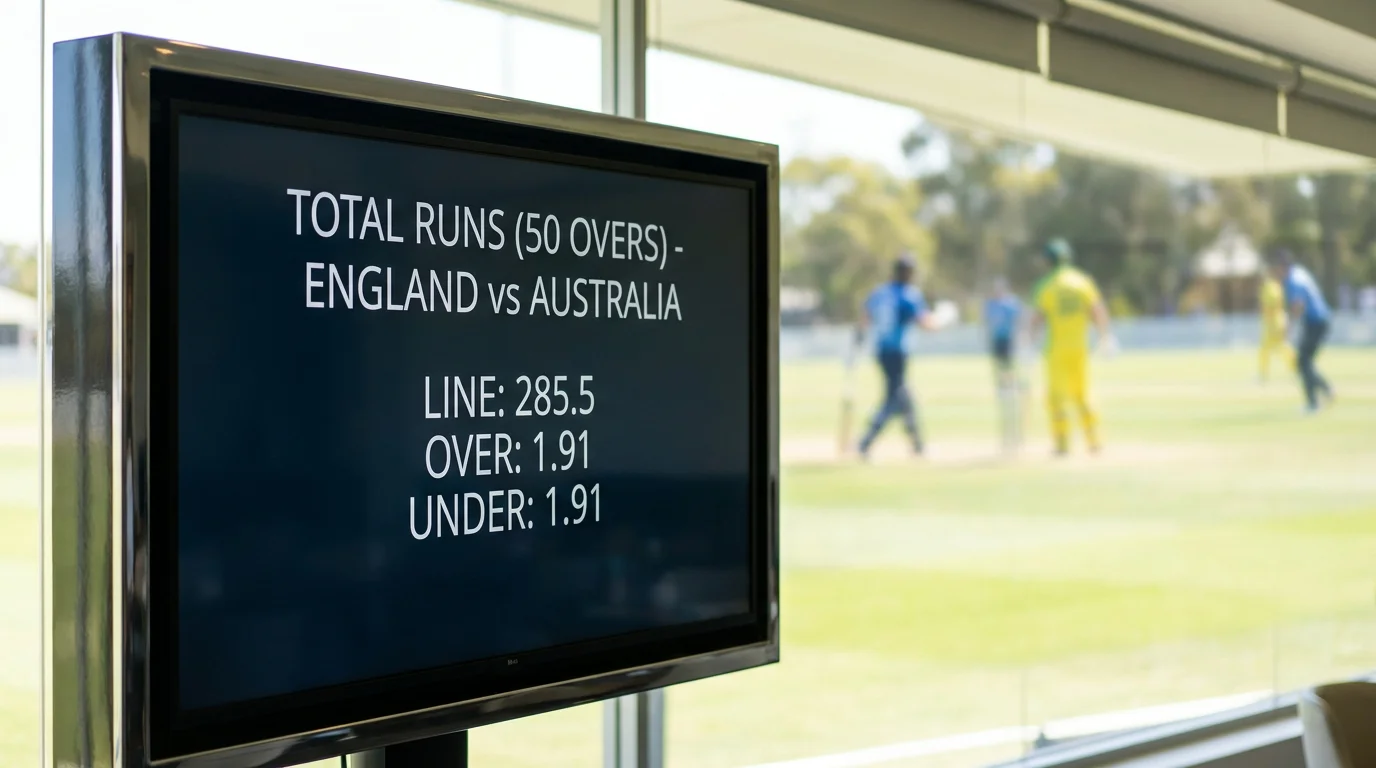
Format transforms these markets completely. A T20 total might hover around 180, a Test innings total in the hundreds, a one-day total in the three hundreds, and the dynamics of each are utterly different. This is the family where matching the market to the format matters most, which I’ll come to shortly. The runs line also branches into more specialised versions, team totals, opening partnership runs, runs in the powerplay overs, each carving the scoring into a different slice. The full mechanics of the over-or-under runs line, including how it settles when rain shortens an innings, are detailed enough that I’ve given them a dedicated guide on over and under runs betting.
What I want you to take from this family is that runs markets reward analysis in a way result markets don’t. Anyone can have an opinion on who wins. Forming an accurate view on whether a total clears 165 in a T20 requires you to actually understand the pitch, the conditions and the teams, and because fewer casual bettors do that work, the prices are often more generous. If you have the patience to read a pitch report and a forecast, this is the neighbourhood where that patience converts into value.
In-Game and Micro-Markets, the Double-Edged Sword of Live Betting
The most addictive markets in cricket are the ones that resolve in minutes, sometimes in a single delivery. Next over runs. Fall of next wicket. Method of dismissal. These micro-markets turn a four-hour match into a stream of tiny, constant betting opportunities, and that’s precisely what makes them both thrilling and dangerous. I treat them with the wariness of a man handling a loaded weapon, because that’s effectively what they are.
These in-game markets exist only because cricket is played as discrete events, and they multiply during live play. You can bet on how many runs come off the next over, whether the next ball is a wicket, how a batsman will eventually be dismissed, whether a team passes a certain score in the next ten overs. The odds update constantly as the match breathes, shortening and lengthening with every ball. For an experienced bettor reading momentum, there’s real opportunity in these shifts. For a beginner, they’re a fast route to betting far more often than is wise.

There’s also an integrity dimension to these markets that you genuinely need to understand, because the very granularity that makes them appealing also makes them targets. Cricket recorded 59 suspicious matches in 2025, a notable rise on the previous year, according to integrity monitoring, and the markets most vulnerable to manipulation are precisely these micro-events, a single over, a specific delivery, a predetermined small outcome that can be fixed without altering the match result. This isn’t a reason to avoid live betting entirely, but it’s a reason to approach the smallest, most obscure markets with healthy suspicion, and a reason the broader subject of live betting demands its own careful, separate treatment.
My honest position on micro-markets is that they’re for later, not for now. The pace at which they invite you to bet is the opposite of the discipline a beginner needs to build. When I started, I avoided them entirely for the first year, and I’d recommend the same. Learn to read a match, develop the patience to let bets run, and only then explore the markets that ask you to make a decision every ninety seconds. They reward sharp, experienced reading and punish impulsive clicking, and most newcomers do far more of the latter.
Novelty and Prop Markets, Fun That Usually Costs You
Every cricket board has a section of markets that exist purely for entertainment, and I want to be honest with you about them. The novelty and prop markets, who wins the toss, will there be a century, which bowler takes the first wicket, are fun, occasionally tempting, and almost always poor value. They’re the seaside arcade of the betting world: enjoyable, harmless in small doses, and absolutely not where anyone makes money.
The defining feature of novelty markets is a high bookmaker margin. Because these markets attract casual, fun-driven bets rather than sharp analytical money, operators build in a fatter cut. The toss market is the purest example, a literal coin flip priced with a margin that guarantees you’re getting the worse side of a fifty-fifty. Method-of-dismissal bets, runs-off-the-first-ball novelties, milestone markets like “will any player score a fifty”, all tend to carry prices that quietly favour the house more than the headline result markets do.
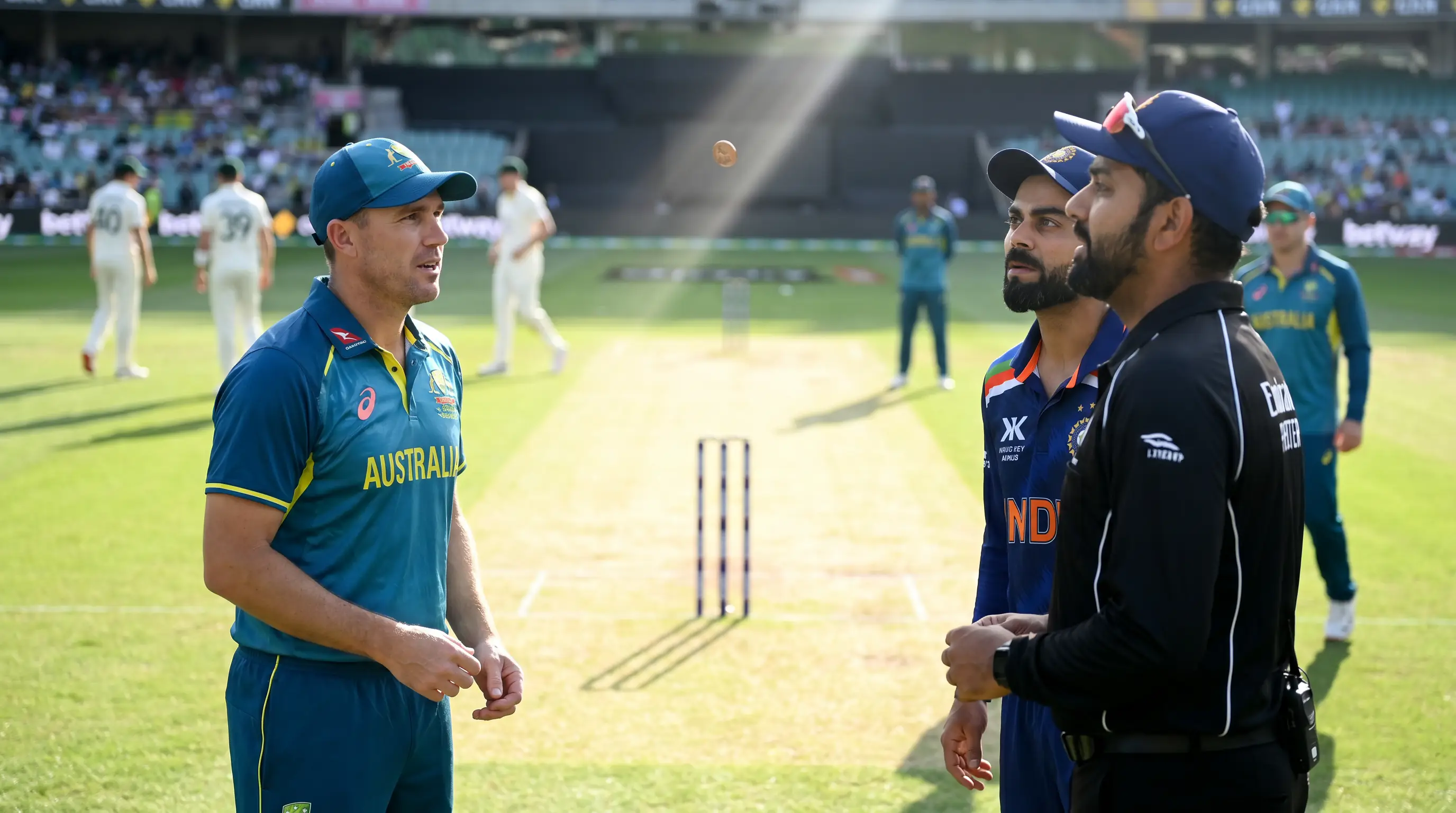
None of this means you should never touch them. A small, fun bet on a novelty market during a big match is part of the enjoyment, and I’m not going to pretend I’ve never backed a toss out of pure superstition. The harm comes when novelty bets become a habit or a meaningful chunk of your staking, because the compounding effect of consistently taking poor value will grind any bankroll down. Treat them as the entertainment line item they are, not as a serious avenue for returns. If you find a novelty market that genuinely seems mispriced, it’s far more likely you’ve misjudged the probability than that the bookmaker has left money on the table in their highest-margin section.
Matching Markets to Formats, the Skill That Ties It All Together
Everything I’ve described changes shape depending on the format you’re watching, and learning to match the market to the format is the meta-skill that pulls this whole field guide together. A market that’s a goldmine in a T20 can be a wasteland in a Test, and a beginner who ignores this will keep wondering why their reasoning doesn’t translate from one game to the next.
The cricket segment is projected to be the fastest-growing part of the global sports betting market, driven specifically by the popularity of short formats like T20 and The Hundred, and that growth concentrates around the markets those formats suit. Short-format cricket, with its high scoring and rapid resolution, suits runs totals, powerplay markets and result bets that settle in an evening. The variance is high, upsets are common, and the markets reflect a game decided by explosive individual overs rather than slow attrition. Player markets in T20 swing wildly because a single big-hitting innings can dominate, making top batsman a lottery but man of the match a more readable bet for an all-rounder.
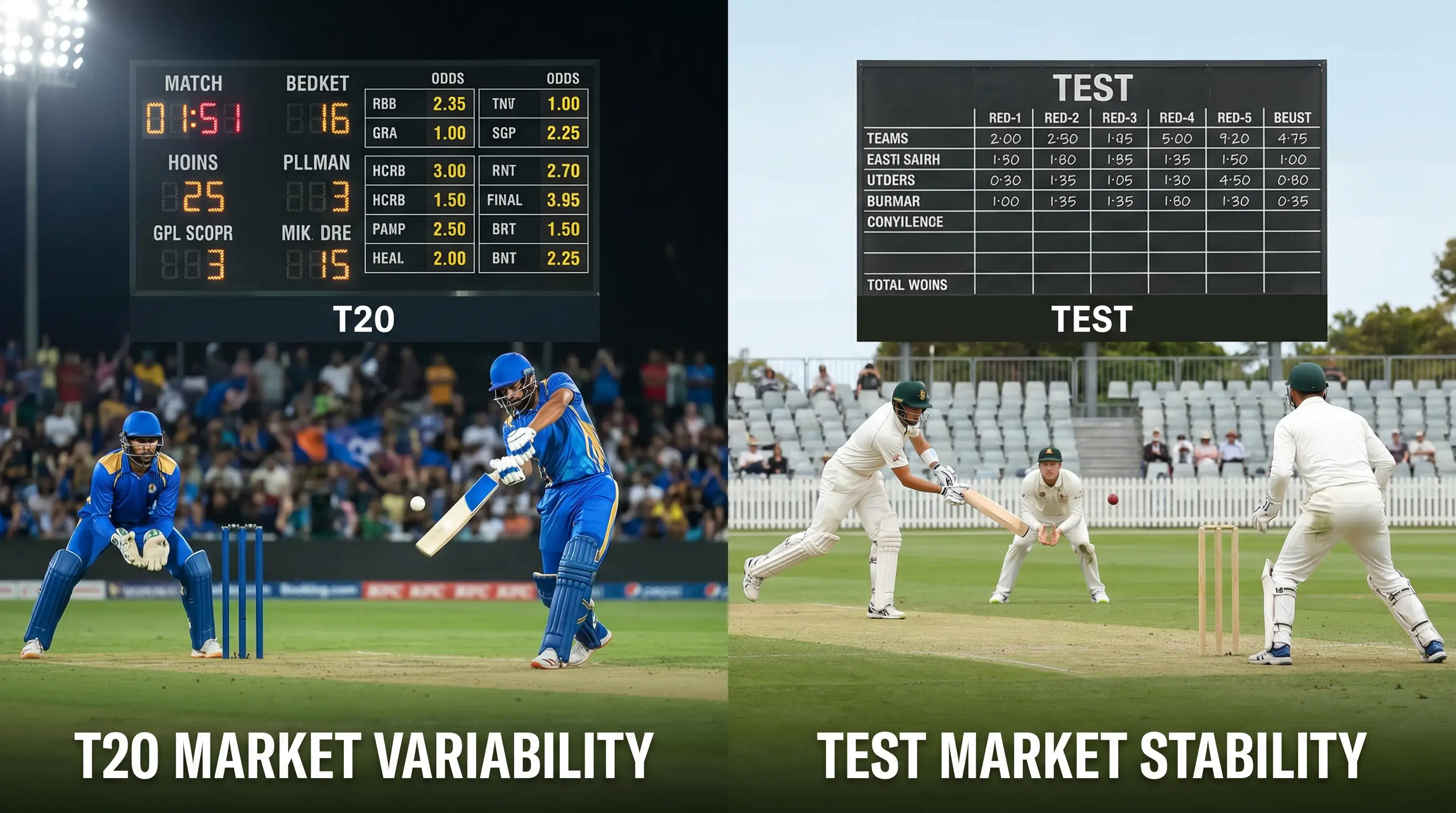
Test cricket inverts almost all of this. The draw makes result markets three-way and rewards the draw-no-bet approach. The five-day span makes session and day markets meaningful in a way they never are in a T20. Conditions evolve across the match, a pitch that’s flat on day one might be crumbling and unplayable by day four, so totals and method markets shift with the ageing surface. The slow accumulation that makes Test cricket an acquired taste for some viewers makes it a rich, layered environment for the patient bettor, full of markets that reward reading the long arc of a match.
So the discipline is this: before you pick a market, identify the format and ask what that format does to the bet. Does the draw matter here? How does the length of the game change the variance? Will conditions shift across the match in a way that affects this market? A top-batsman bet, a total-runs line and a match-winner price each behave completely differently across T20, one-day and Test cricket, and the bettor who internalises those differences stops making the rookie error of applying T20 logic to a Test, or vice versa. The markets are the same families everywhere. How they behave is dictated entirely by the format, and reading that is what turns a map of the territory into the ability to actually find your way around it.
Which cricket market has the lowest bookmaker margin?
The high-liquidity result markets, particularly match winner in limited-overs cricket and major totals lines, typically carry the tightest margins, because they attract heavy, sharp money that forces operators to price keenly. Novelty and micro-markets sit at the opposite end, with fatter margins built in because they draw casual rather than analytical betting. As a rule, the more popular and heavily-bet a market is, the better value you tend to get, which is one reason I steer beginners towards the main result markets.
Are player markets riskier than match-winner markets?
Considerably, yes. Player markets like top batsman involve far more variables and far longer odds, because any of several players might top-score or win an award, and a single delivery can end a favourite’s innings. Match-winner markets have only two or three outcomes and are driven by overall team strength, making them more predictable. Player markets aren’t bad bets, but they demand more analysis and carry higher variance, so they suit experienced bettors more than newcomers.
How many markets does a typical Test match offer?
A major Test match on a full-service operator can offer well over a hundred distinct markets across result, player, runs, session, method and novelty families, with even more appearing once live in-play betting opens up. The five-day format and ball-by-ball structure of cricket generate far more wagering opportunities than most sports. You don’t need to engage with more than a handful, though, and trying to bet across all of them is a classic beginner mistake rather than a strategy.
