
 Available in US
Content
There’s a number sitting inside every cricket market you’ve ever bet that the bookmaker would really rather you didn’t add up. Take the implied probability of every possible outcome, total them, and you’ll find they come to more than 100 per cent. That extra slice, the bit beyond a fair 100, is the house’s cut, and it’s the single most important thing to understand about why betting is hard to beat. Most punters never calculate it once. The ones who win calculate it on every market they touch.
The bookmaker margin, also called the overround or the “vig”, is the amount by which a market’s prices are shaded in the bookmaker’s favour. It’s not a fee you see on a receipt; it’s woven invisibly into the odds themselves, which is exactly why it’s so easy to ignore. Understanding it doesn’t let you avoid it, but it lets you measure it, compare it, and steer toward the markets where it bites least, and over a season that steering is worth a genuine amount of money.
What Overround Actually Is
Imagine a perfectly fair coin toss where a friend offers you evens on heads and evens on tails. Back both and you can’t lose or win; you’ve covered every outcome at a price that exactly reflects its chance. Now imagine your friend quietly shortens both to 10/11. Cover both outcomes now and you’re guaranteed to lose a little, no matter how the coin lands. That guaranteed shortfall is the overround, and it’s the engine of every bookmaker on earth.
The mechanism is simple once you see it. A fair two-way market should have implied probabilities summing to 100 per cent, because between them the two outcomes are certain to produce one winner. The bookmaker prices each outcome slightly shorter than its true chance, so the implied probabilities sum to perhaps 104 or 106 per cent. That overage above 100 is the margin. On a coin toss it’s pure profit baked into the price; on a cricket match it’s the same idea spread across however many outcomes the market contains.

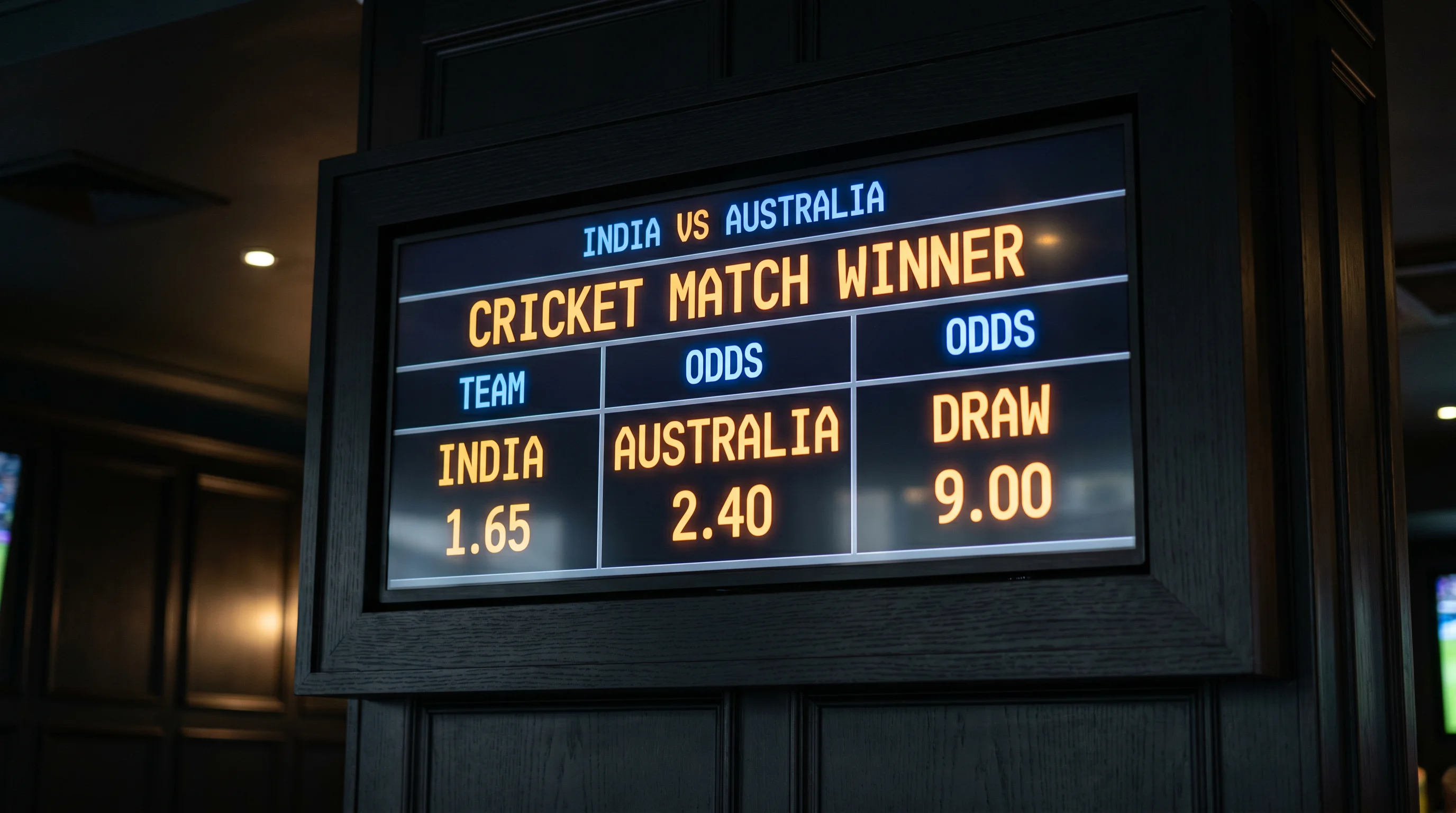
Cricket complicates this beautifully because so many of its core markets are three-way rather than two-way. A Test match can be won by either side or drawn, which means three prices to shade instead of two, and three outcomes give the bookmaker more places to tuck margin away where you won’t notice it. That’s why I always treat a three-way Test result market with a touch more suspicion than a two-way limited-overs one: there’s simply more room for the house to hide its cut.
Calculating the Margin on a Real Market
The first time I actually worked out the overround on a market I’d been happily betting for years, I felt slightly sick. I’d assumed a margin of a few per cent. The reality on some of the novelty markets I’d been dabbling in was considerably uglier, and it explained a losing run I’d been blaming on bad luck. Bad luck had nothing to do with it. I’d been paying a tax I never bothered to read.
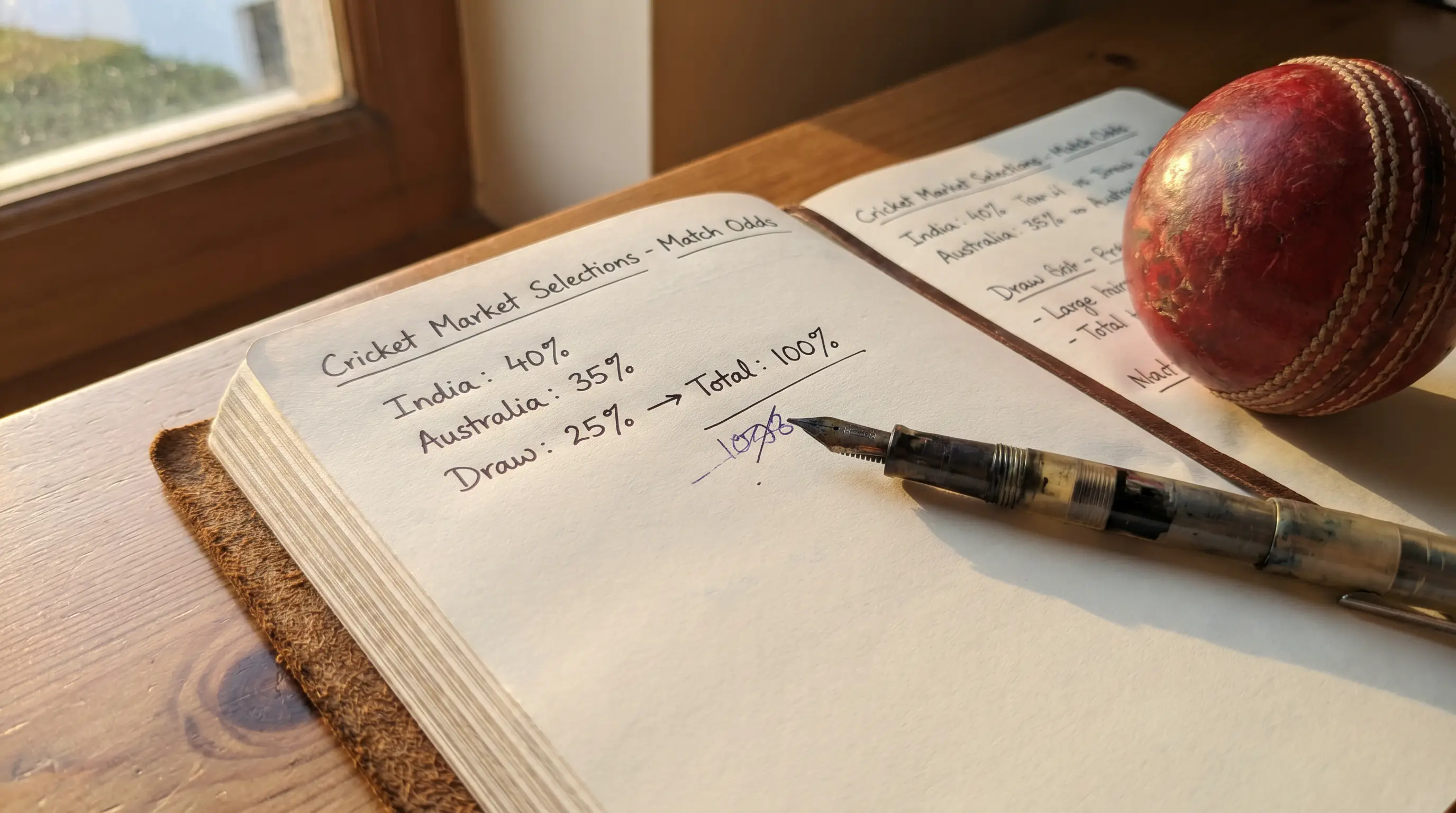
Here’s the method, and it takes about thirty seconds. Convert each price in the market to its implied probability by dividing 100 by the decimal odds, then add those percentages together. If a limited-overs match offers Team A at 1.80 and Team B at 2.10, that’s 55.6 per cent plus 47.6 per cent, totalling 103.2 per cent. The margin is whatever sits above 100, so here it’s 3.2 per cent. That’s a tight, competitive market, the kind you’ll find on a high-profile international where bookmakers compete hard for turnover.
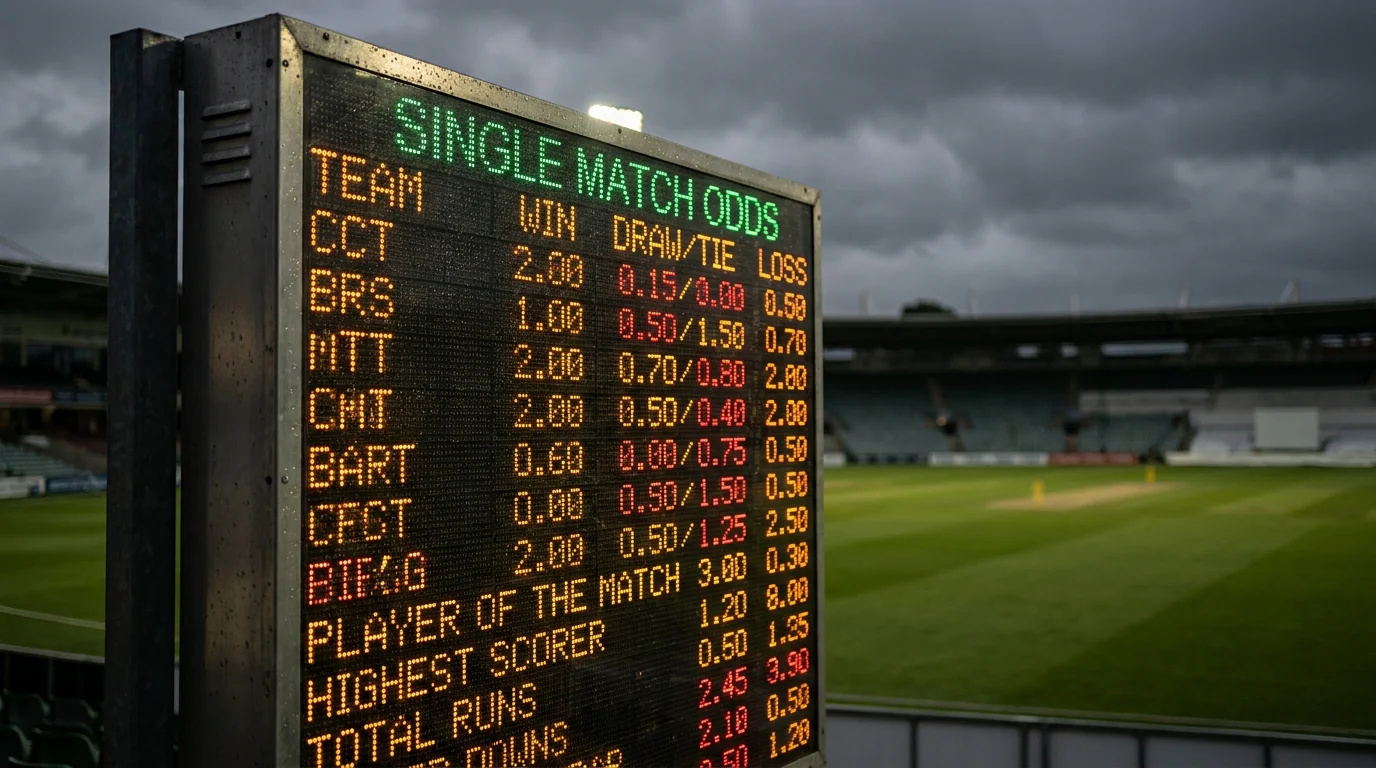
Now run the same sum on a fussy little prop market, say first-innings method of dismissal, and you might find the probabilities totalling 115 or 120 per cent. That 15 to 20 per cent margin means the deck is stacked far more steeply against you before a ball is bowled. The arithmetic is identical; only the result is alarming. If the conversion from odds to probability is the step that’s slowing you down, it’s worth nailing that percentage-reading habit cold before you start margin-hunting in earnest, because the whole calculation rests on it.
These aren’t abstract sums against a small market either. UK sports betting was generating around 2.48 billion pounds a year in gross gambling yield heading into 2026, and gross gambling yield is, at its heart, the accumulated margin the industry keeps after paying out winners. When you calculate an overround you’re not doing a maths exercise; you’re reading, market by market, the precise mechanism that produces that 2.48 billion. Every percentage point you decline to pay is a point that stays in your pocket.
Steering Toward the Markets That Cost You Least
If there’s one habit I’d hand to a newer bettor, it’s this: before you fall in love with a selection, check what the market is charging you to play it. Two punters can back the same opinion, one through a tight 3 per cent market and one through a bloated 18 per cent one, and over a thousand bets the first will be thousands of pounds better off purely on margin. The opinion was identical. The toll booth was not.

The reliable pattern is that margin tracks liquidity and attention. High-profile, high-volume markets carry thin margins because bookmakers compete fiercely for that turnover, and the concentration of UK betting is striking: William Hill and Bet365 together pulled in more than half of all British betting search clicks in early 2026, which gives you a sense of how hard the biggest operators fight over the marquee markets. The flip side is that obscure, low-volume markets, your novelty props and your micro-markets, carry fat margins precisely because nobody’s competing to price them keenly and the bookmaker can afford to be greedy.

So the practical rule writes itself. Favour the headline result and totals markets on big matches, where the overround is squeezed thin by competition, and treat the exotic props as the expensive entertainment they are rather than as a path to profit. I’m not saying never touch a novelty market; I’m saying know that you’re paying a premium when you do, and size your stake accordingly. There’s one structural way to sidestep bookmaker margin almost entirely, which is to bet against other punters rather than against the house, and that’s a different model worth understanding in full over in my piece on the betting exchange in cricket.
The margin never disappears. It’s the price of admission to a market someone else has built and is running for profit, and that’s a fair enough deal. But it’s a deal you should enter with your eyes open, knowing exactly what you’re being charged and choosing, deliberately, to pay it only where it’s cheapest. Do that consistently and you won’t beat the bookmaker overnight, but you’ll stop quietly handing them more than the game requires, and in a pursuit this finely balanced, not overpaying is most of the battle.
Why is the margin higher on novelty cricket markets?
Novelty and prop markets attract low betting volume and little competition between bookmakers, so there’s no pressure to price them keenly. The house can afford to shade the odds heavily, which is why their overround often runs to 15 or 20 per cent against perhaps 3 per cent on a headline match-result market.
Does a betting exchange have a margin?
Not in the same way. An exchange matches punters against each other rather than pricing a book, so there’s no overround built into the odds. Instead it takes a commission on net winnings, which is typically far smaller than a bookmaker’s margin, especially on liquid markets.
