
 Available in US
Content

Every winning cricket bettor I’ve ever known believes the same unglamorous thing: that backing winners is not the goal. The goal is backing value, getting a price that’s bigger than the true chance of the outcome, and over enough bets the value wins out whether or not any individual selection comes in. It’s a hard idea to love, because it asks you to feel good about a losing bet that was correctly priced and bad about a winning bet that wasn’t. But it’s the only idea in betting that actually works.
Value betting means staking only when the odds on offer are longer than the real probability of the outcome justifies, so that the price overpays you for the risk you’re taking. It’s the opposite of betting on who you think will win; it’s betting on where the bookmaker has got the price wrong. Master it and you have the one durable edge in cricket betting. Ignore it and no amount of cricketing knowledge will keep you ahead of the margin.
It’s worth keeping the wider risk picture in view, because chasing value can curdle into chasing losses if discipline slips. A government minister, introducing reforms aimed at the most dangerous gambling products, warned that “online slots are the highest-risk gambling product. They have the highest rate of binge play and the highest average losses of any online product.” Value betting is the antidote to exactly that mindset, the slow, disciplined, low-emotion approach that treats each bet as a priced decision rather than a chase, and keeping it that way is as much about temperament as arithmetic.
Defining Value Against the Price
The cleanest definition of value I know is this: a bet has value when you’d take it an infinite number of times and come out ahead, regardless of what happens on any single occasion. That sounds abstract until you ground it in a number, and the number is the gap between the true probability and the implied probability of the price.
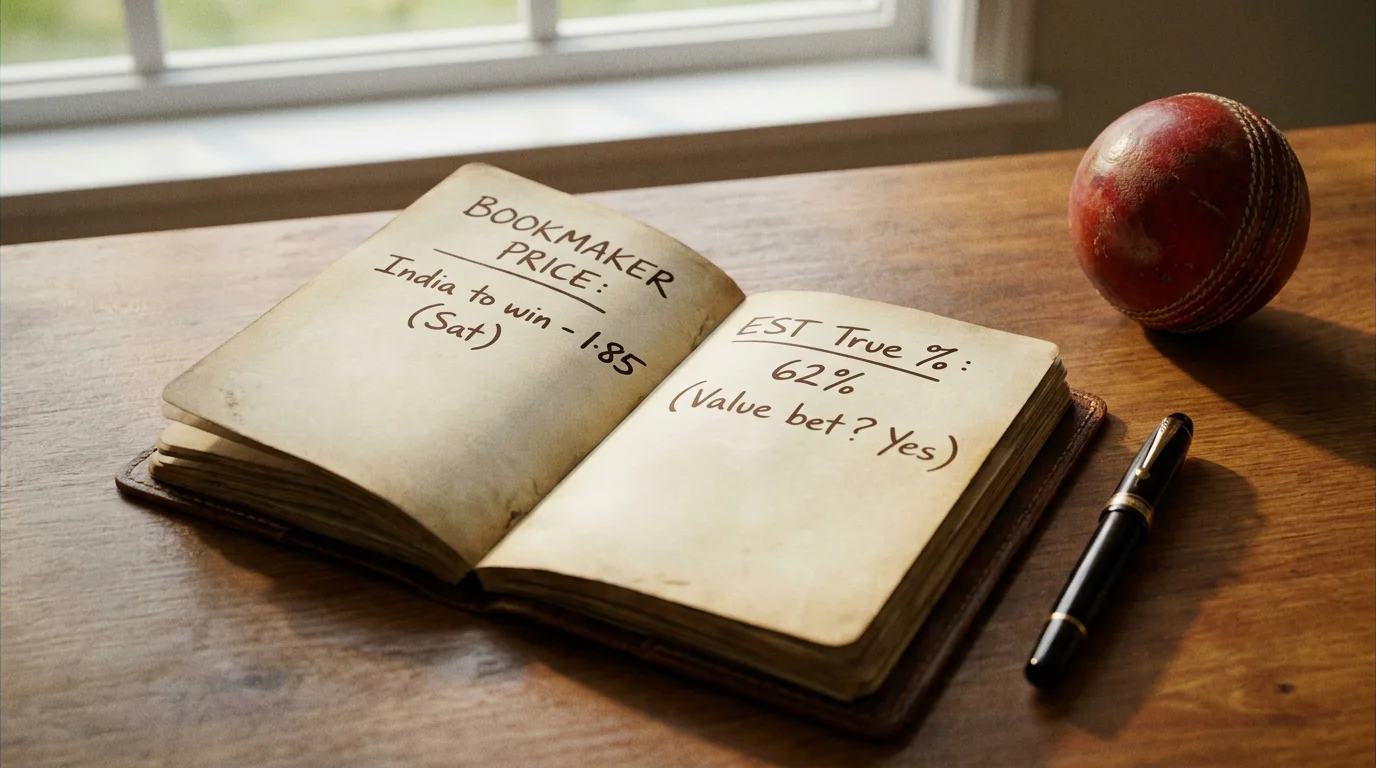
Here’s the mechanism. Every price carries an implied probability, the chance the odds say the outcome has, which you find by dividing 100 by the decimal price. Value exists when your honest estimate of the true probability is higher than that implied figure. If a team is priced at 2.50, the implied probability is 40 per cent, and if you genuinely believe they’re a 50 per cent chance, the price is paying you as though they’re rarer than they are. That’s value, and betting it repeatedly, across many such gaps, is mathematically profitable even though you’ll lose plenty of individual bets along the way. The whole discipline rests on being able to convert a price into a probability fluently, which is the foundational skill, and I’ve walked through it in detail in my guide to cricket implied probability.

The hard part isn’t the arithmetic; it’s the honesty. Value betting demands an unflinching estimate of the true probability, uncontaminated by which team you like, which narrative is appealing, or which result you’d enjoy. Your estimate has to be your genuine best read of the chance, and then the only question is whether the price is generous against it. Most punters never do this, betting instead on who they think will win without ever asking whether the price compensates them for the risk, which is precisely why most punters lose. The value bettor is doing something fundamentally different: hunting for prices that are wrong, not outcomes that are likely.
Spotting Mispriced Cricket Markets
The natural question is where these mispriced markets actually hide, because if value were obvious, the market would erase it. The answer is that value clusters in the places where the bookmaker’s price is least sharp and the crowd’s money is least informed, and cricket offers more of those places than most sports.

The headline markets on marquee internationals are brutally efficient, priced by sophisticated models and kept honest by huge volumes of sharp money, so value there is rare and fleeting. The value lives at the margins: the thin county markets nobody bothers to price tightly, the women’s competitions that attract less saturating money, the niche performance and conditions markets where genuine cricketing insight beats a model that’s working from thinner data. It also lives wherever the crowd bets on sentiment, the famous team coasting on reputation, the Ashes favourite backed by patriotism rather than analysis, because emotional money pushes prices away from the truth and leaves value on the other side. The global cricket betting market, worth around 76.5 billion US dollars in 2023 and forecast past 151 billion by 2032, is so vast and so varied that no bookmaker prices every corner of it equally well, and the inefficiencies the value bettor hunts are the inevitable result of that scale.
Finding these spots requires doing work the casual bettor won’t, and that’s the whole edge. It means following the unglamorous cricket, knowing the conditions, the squads, the venue quirks that the broad market underweights, and being willing to bet a thin market at a keen price rather than a liquid one at a sharp one. The value bettor isn’t smarter than the bookmaker’s model on a World Cup final; they’re better informed than the lazy money on a county game, a women’s match, or a conditions-dependent market the model handles crudely. That’s where the gaps are, and closing the gap between effort and reward is the practical heart of value betting.
Staking and the Patience Value Demands
Finding value is only half the job; the other half is staking it sensibly and surviving the variance long enough for the edge to pay off. A value bet is still a bet, and a 50 per cent chance loses half the time, so even a portfolio of genuinely good value bets will endure losing runs that test the nerve of anyone who hasn’t prepared for them.

Sensible staking means sizing bets in proportion to your bankroll and your edge, never betting so much on a single selection that a normal losing run can damage you. The variance in cricket is severe, the freak collapse, the weather, the unexpected hero, and a value bettor who stakes too aggressively will be wiped out by ordinary bad luck before their edge has time to express itself. Betting is a mass-market pastime in Britain, with overall four-week participation running at 27 per cent once lottery-only players are excluded, yet the great majority of those bettors stake on feel rather than on a priced edge, which is exactly why disciplined staking is such a quiet differentiator. I size my bets to ride out the inevitable cold streaks, because the entire premise of value betting is that the edge compounds over a long sequence, and you only collect that compounding if you’re still solvent when the variance turns. The discipline of stake sizing is what separates a value bettor who profits from one who has the right idea and goes broke anyway.

The patience this demands is the hardest part, and it’s where the connection to responsible betting becomes concrete rather than preachy. Value betting requires accepting losing bets that were correctly priced without chasing them, resisting the urge to abandon a sound approach during a cold run, and treating the whole thing as a slow accumulation rather than a source of excitement, which is the polar opposite of the binge-play, high-loss pattern that makes products like slots so dangerous. The temperament that makes a good value bettor, calm, disciplined, long-horizoned, is the same temperament that keeps betting healthy and keeps it from sliding into the binge-play, high-loss pattern that makes the riskiest products so harmful. Value betting, done properly, is patient, unemotional and slow, and that’s exactly why it works when nothing else does.
Can you win long term without finding value?
No. Without value, you’re betting prices that are fair or worse, and the bookmaker’s margin guarantees a long-term loss however many individual bets come in. Backing winners isn’t enough; you have to back outcomes priced longer than their true probability, because that gap is the only thing that overcomes the margin over time.
How does the margin eat into value?
The bookmaker’s margin shades every price slightly against you, so the implied probability you calculate from a price is higher than the bookmaker’s true estimate. That means a price has to be generous enough to clear both your genuine edge and the built-in margin before it’s truly value, which is why value is rarer in tightly-priced markets than in thin, lightly-bet ones.
