
 Available in US
Betting on Cricket: A Data-Led UK Guide
The first cricket bet I ever placed lost in the most cricketing way imaginable. I had backed a comfortable home win, the favourite was 140 for 2 at lunch on day four, and then it rained for two sessions and the match crawled to a draw. My stake was gone, not because I had misread the teams, but because I had not understood the one thing that separates cricket from almost every other sport you can bet on: the draw is a real, frequent, money-deciding outcome, and the weather is a player in its own right. That was seven years ago. I have spent every season since pulling cricket markets apart for a living, and the lesson from that first slip still sits at the centre of how I think.
Betting on cricket means staking money on the outcome of a match or on specific events within it, with a bookmaker or exchange that holds a licence from the Gambling Commission. That definition sounds the same as betting on football or tennis, and that is exactly the trap. Cricket is not just another fixture on the coupon. It comes in formats that last anywhere from three hours to five days, it offers session and innings markets that exist nowhere else, and it is played on a surface that changes character hour by hour. A Test match in Birmingham and a hundred-ball game in Cardiff are barely the same sport when you look at them through a betting lens, and pricing them as if they were is how money leaks away.
The market itself has shifted under our feet. The Gambling Commission has watched the betting public broaden out beyond the old staples, and as its former chief executive Andrew Rhodes put it, operators are reporting sports beyond traditional horseracing and football growing in use, cricket among them. That is the backdrop for this guide. Over the next few thousand words I will walk you through how the odds work, what the main markets actually settle on, how the formats reshape your thinking, what the UK market and its regulation look like in 2026, and how to keep the whole thing safe and sustainable. This is the overview. Where a topic deserves its own deep dive, I will point you to it.
The Short Version Before You Stake
- Cricket betting means staking on a match result or in-match events with a Gambling Commission licensed operator, and it is legal in Britain if you are eighteen or over.
- Odds are just a price on probability: divide 100 by the decimal price to get the implied percentage chance, then compare it with your own read.
- The format changes everything, and the draw plus the weather are live variables no other sport forces you to price.
- Around 22.5 million UK adults bet monthly, and the market generates roughly 2.48 billion pounds in gross gambling yield a year.
- Cricket logged 59 suspicious matches in 2025, almost all in granular in-game markets, so set limits and stay licensed.
What You Are Actually Betting On
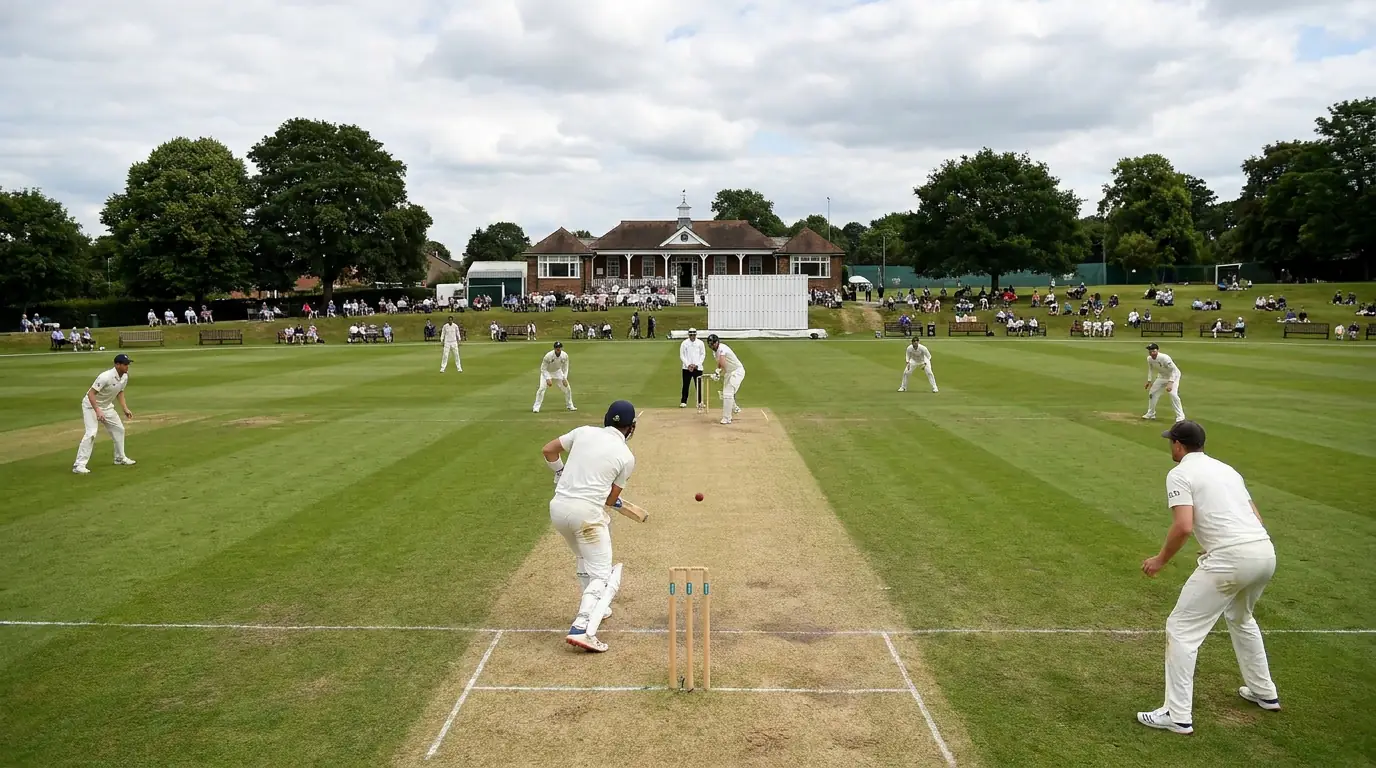
Ask ten people what cricket betting is and nine will say "betting on who wins." They are not wrong, but they are describing maybe a fifth of what is on offer. The win market is the front door. Behind it sits a building with dozens of rooms, and the punters who do well are the ones who know which room they have walked into.
At its simplest, a cricket bet is an agreement: you stake an amount, the bookmaker offers odds, and if your prediction lands you collect your stake plus winnings calculated from those odds. What changes everything is the sheer range of things you are allowed to predict. You can back the match result, of course. But you can also bet on which player scores the most runs, how many runs are scored in a single over, whether a total crosses a line the bookmaker has drawn, who wins the toss, and which side leads after the first session of play. Some of these resolve in two minutes. Others take five days.
Stake — the amount of money you commit to a bet. Your potential return is your stake multiplied by the odds, and your stake is the most you can lose on a standard fixed-odds bet.
This breadth is not an accident, and it is not slowing down. The cricket segment is forecast to be the fastest-growing slice of the global sports betting market, driven almost entirely by the short formats that have exploded in popularity over the past decade. Twenty-over cricket and the hundred-ball game compress a result into an evening, which suits both broadcasters and bettors, and bookmakers have responded by building out market menus that would have looked absurd in the era when a county game over four days drew a handful of prices and nothing more.
Three things make cricket distinct as a betting product. First, format length ranges from a few hours to five days, which changes how odds behave and how often the draw matters. Second, in-game markets like sessions and individual overs let you bet on fragments of a match rather than just its end. Third, the playing surface and the weather are not background noise but active variables that bookmakers price into every line.
If you are completely new to this and want the mechanics of actually getting money down, I have written a full walkthrough on getting your first cricket bet placed that covers account setup, the bet slip and your opening stake. This section is the map; that one is the turn-by-turn directions. For now, hold onto the core idea: cricket gives you more ways to be right and more ways to be wrong than almost any sport on the board, and the skill is in choosing which questions you are confident enough to answer.
One more framing point before we get into the numbers. Every legitimate cricket bet you place in Britain happens inside a regulated system. The operator holds a licence, the odds are published, and there are rules about how markets settle and how disputes are handled. That regulation is not a footnote. It is the reason a losing bet is just a losing bet and not a scam, and it shapes everything from the prices you see to the protections you can lean on. We will get to the detail of that later, but keep it in mind as the floor under all of this.
Reading the Price Tag
Here is a question I put to people who tell me they "don't get odds": if I offered you 2/1 that the next coin I flip lands heads, would you take it? Most say yes instantly, because they know a coin is roughly 50/50 and 2/1 implies something far less likely. They understand odds perfectly. They just freeze when the same idea is dressed up in betting language. Odds are nothing more than a price tag on a probability, and once you see them that way the mystery evaporates.
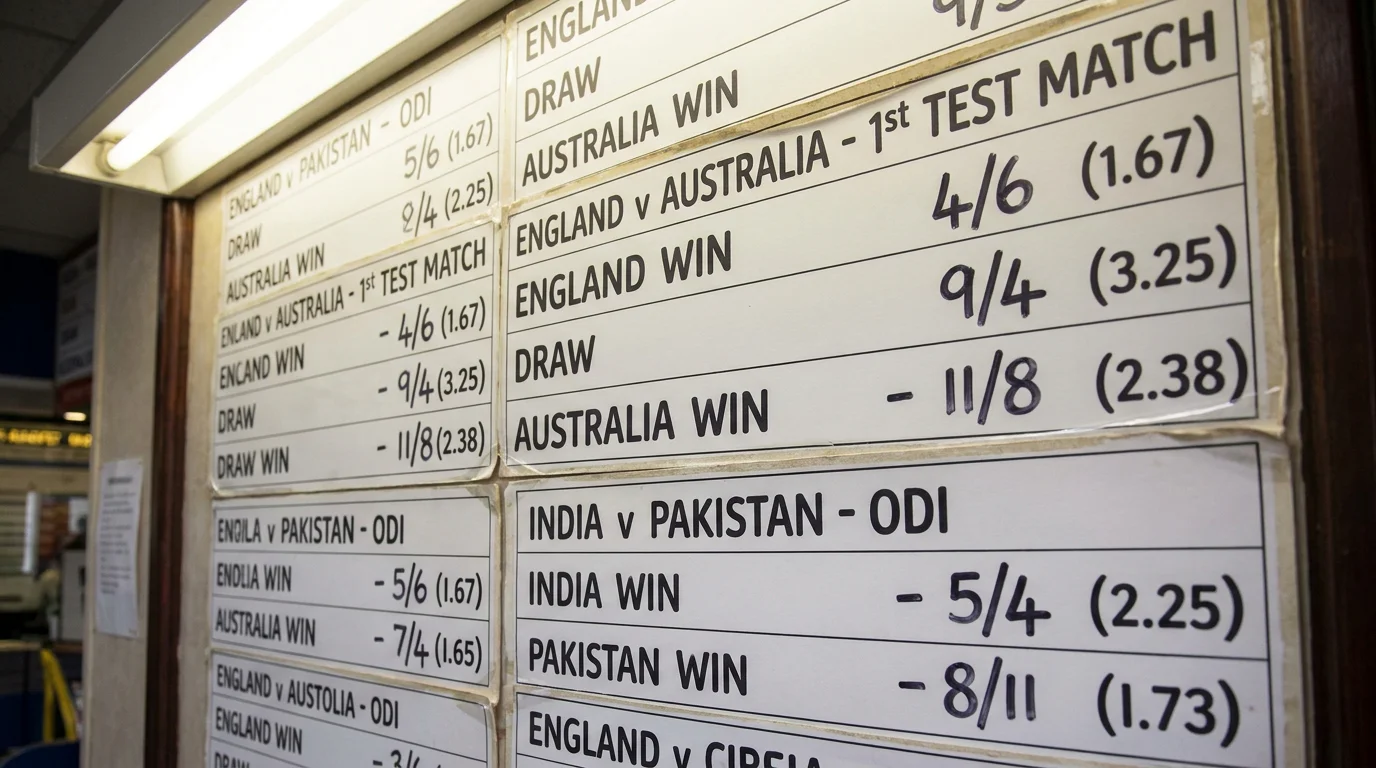
In Britain you will meet odds in two costumes. Fractional odds, the traditional format, look like 5/2 or 11/4 and tell you how much profit you win relative to your stake. Decimal odds, increasingly the default online and the standard on exchanges, look like 3.50 or 3.75 and tell you your total return per unit staked, stake included. They describe exactly the same thing. A price of 3/1 fractional is 4.00 decimal; both mean a four-pound return on a one-pound stake when you win.
| Aspect | Fractional odds | Decimal odds |
|---|---|---|
| Looks like | 5/2, 11/4, 6/4 | 3.50, 3.75, 2.50 |
| What it shows | Profit relative to stake | Total return including stake |
| "Evens" appears as | 1/1 | 2.00 |
| Where you see it most | High street, traditional UK display | Online sportsbooks, betting exchanges |
| Easier for | Quick high-street familiarity | Comparing prices and calculating returns |
Let me show you the arithmetic with a clean, brand-free example so the relationship sticks.
Example calculation: a 10-pound stake at different prices
Suppose a team to win is priced at 6/4 fractional, which is 2.50 decimal. With fractional, you read it as "four pounds staked returns six pounds profit," so 10 pounds returns 15 pounds profit plus your 10 back, for 25 total. With decimal, you simply multiply: 10 times 2.50 equals a 25 total return. Same money, two notations.
Now flip it into probability. Decimal odds convert to an implied chance by dividing 100 by the price: 100 divided by 2.50 is 40 percent. The bookmaker is effectively saying this team wins four times in ten. If your own read says they win closer to half the time, you have found something worth a closer look.
That last move, turning a price into a percentage, is the single most useful habit you can build, because it lets you compare what the market thinks against what you think. It is the foundation of finding value, and it is worth practising until it is second nature. I have laid out the full method, including the head-maths shortcuts for converting fractions to decimals on the fly and the quirks of reading a live market board, in a dedicated guide on reading cricket betting odds in both formats.
The one warning I will give here, and repeat later, is about the gap between the implied probabilities and reality. Add up the implied chances of every outcome in a market and you will get a number above 100 percent. That overshoot is the bookmaker's margin, the built-in edge that funds the business. It is not a flaw you can complain about; it is the cost of doing business, and the punters who win long term are simply the ones who beat it more often than they pay it. Understanding that a 40 percent implied probability is not quite the bookmaker's true estimate, but their estimate plus a slice of profit, is the difference between betting blind and betting with your eyes open.
The Markets, From Front Door to Back Room
A friend once asked me to "just put a tenner on the cricket" and was genuinely baffled when I asked which of about forty things he wanted to bet on. To him there was one bet: who wins. To me the match-winner market is where the casual money goes and where the bookmaker margin is often thinnest precisely because so much money flows through it. The interesting questions live elsewhere.
Cricket markets sort naturally into a few families, and knowing the family tells you most of what you need before you even look at a price. Result markets cover the outcome of the match or series: the straight winner, the three-way result that includes the draw, and outright markets on who lifts a trophy at the end of a competition. Player markets ask which individual does something: top batsman for a team or the whole match, top bowler, or the player of the match award. Totals markets draw a line and ask whether the real number lands above or below it, whether that is total match runs, an individual innings, or a single over. And then there are the in-game and micro markets that only really come alive once play has started.
Result markets
Match winner, three-way result with the draw, series winner and correct series score, tournament outright.
Player markets
Top batsman, top bowler, player or man of the match, individual runs and wickets lines.
Totals markets
Total match runs, innings totals, runs in a single over, sixes and boundaries over or under a line.
In-game markets
Session and bracket runs, next-wicket method, race to a set total, live match odds that update ball by ball.
The reason this taxonomy matters is that each family carries a different risk profile and a different margin. Match-winner markets are usually the most efficient, which is a polite way of saying they are the hardest to beat, because the whole world is pricing them. Novelty and prop markets, the "will there be a hat-trick" or "method of first dismissal" lines, tend to carry fatter margins because they are harder to model and the bookmaker builds in more cushion. Player markets sit somewhere in between, and they reward genuine cricket knowledge more than the headline result does, because a punter who understands batting orders and matchups can disagree with a price for good reasons.
There is also a settlement subtlety that catches people out constantly. A top-batsman bet can be subject to dead-heat rules if two players finish level, which quietly halves your effective odds. A player-of-the-match bet can be won by someone on the losing side. A market that looks identical across two bookmakers can settle differently depending on whether they count a single innings or the whole match. The small print is not pedantry; it is where surprises hide, and reading it before you stake is one of the cheapest habits in the game.
I am keeping this deliberately broad, because each of these markets genuinely deserves its own treatment, and trying to cover every settlement rule here would turn this guide into a manual. If you want the full catalogue, with the strengths, traps and best use of each market type, I have put it together in a dedicated piece on the main cricket betting markets and how they settle. Think of what you have just read as the directory board in the lobby; that guide walks you into each room.

Why the Format Changes Everything
I keep a private rule that I break at my peril: never carry a betting instinct from one cricket format into another without checking it first. A total that looks enormous in a Test innings is routine in a one-day game and almost quaint in the shortest formats. The same line, the same sport, wildly different meaning, and the punters who lose steadily are usually the ones treating all cricket as one thing.
The format dictates the rhythm of scoring, the relevance of the draw, and which markets are even worth your time. A five-day Test is a war of attrition where bowling sides build pressure, collapses happen in clusters, and the draw is a live outcome that can swallow your match-winner bet whole. A fifty-over international compresses that into a single day with a clear winner almost guaranteed, which makes chasing totals and par scores the heart of the action. The twenty-over game and the hundred-ball format strip it down further into a sprint, where a single big over reshapes the match and runs-line markets swing violently.
| Format | Length | Draw a factor | What drives betting |
|---|---|---|---|
| Test | Up to five days | Yes, frequently | Conditions, sessions, the draw, follow-on |
| One-day international | One day, 50 overs each | Rare | Chasing, par scores, phase scoring |
| Twenty-over | About three hours | Very rare | Big overs, totals, powerplay impact |
| Hundred-ball | Around two and a half hours | Very rare | Compressed scoring, rapid momentum swings |
The newest of these is worth dwelling on, because it tells you how fast this market moves. The hundred-ball competition was launched in 2021 as the governing body's answer to the franchise leagues spreading around the world, with each side facing a hundred deliveries rather than the hundred and twenty of a twenty-over game. It was designed for a fresh audience and a tight broadcast window, and it has become a genuinely popular betting fixture in its own right, with bookmakers building dedicated market menus for both the men's and women's competitions.
The County Championship has been running since 1890, making it the oldest domestic competition in England and Wales. Eighteen counties across two divisions play a season that stretches from April to September, which hands bettors one of the longest continuous betting calendars in world cricket.
That contrast, a competition born in 2021 sitting alongside one that predates the motor car, is the whole story of cricket betting in Britain. You have short-format sprints designed for the phone in your hand and four-day grinds that reward patience and local knowledge of early-season pitches. Each rewards a different kind of bettor. The short formats are volatile and forgiving of a quick read; the long formats are slow and punish anyone who ignores the surface and the sky.
Practically, this means your first decision is not which team but which format suits how you actually like to bet. If you want a result by bedtime, the limited-overs and hundred-ball games are your home. If you enjoy reading a match develop over days and exploiting the way odds drift and swing, Test cricket is where the depth is. The mistake is drifting between them on autopilot, applying a twenty-over instinct to a Test total or a Test patience to a sprint that is already half over. Match the format to your temperament and half the work is done before you stake a penny.

Before the First Ball Versus During the Match
The most expensive habit I see in newer bettors is treating a live match like a casino floor, jabbing at the screen every time something happens. Cricket in particular tempts you into it, because the action arrives in discrete events, every ball a tiny verdict, and each one feels like a fresh chance to be clever. Knowing the difference between betting before play and betting during it is the difference between a considered position and a slot machine.
Pre-match betting is the calm version. The odds are set, you have time to think, you can compare prices and read the team news, and once your stake is down you wait. In-play, or live, betting flips that on its head. The odds update continuously as the match unfolds, a wicket can send a price tumbling in seconds, and the whole appeal is reacting to information the pre-match market did not have. Both are legitimate. They simply demand different temperaments.
| Aspect | Pre-match | In-play |
|---|---|---|
| When you bet | Before the first ball | While the match is live |
| Odds behaviour | Fixed once placed | Update ball by ball |
| Pace of decisions | Slow, considered | Fast, reactive |
| Main edge | Research and value-hunting | Reading momentum live |
| Main risk | Acting on stale assumptions | Over-betting on impulse |
The thing that makes live cricket betting genuinely distinct is the granularity. You are not just betting on the result as it shifts; you can bet on the next wicket, the runs in the current over, or who leads after a session. That density is the attraction and the danger in one. It is also why this part of the market carries a particular integrity sensitivity that the pre-match market does not, since individual passages of play are far easier to manipulate than a whole result, which is why the in-game markets attract the closest scrutiny from the monitors. I will come back to what that means for you a little later.
I am not telling you to avoid live betting. I do plenty of it, and reading momentum in running is one of the more rewarding skills in the sport. But it rewards discipline far more than it rewards enthusiasm, and the mechanics, cash-out, the way odds freeze between deliveries, and the conditions that move live prices, deserve proper attention rather than a paragraph. I have written all of that up in a dedicated guide on betting on cricket while the match is live. For the purposes of this overview, hold two ideas: pre-match is where you think, in-play is where you react, and the bettors who blur the two without noticing are usually the ones funding everyone else.

The Two Variables No Other Sport Has to Price
Picture a football match where the pitch itself slowly turned from grass to sand over four days, favouring one style of play in the morning and the opposite by evening, while a cloud passing overhead could swing the result. That sounds absurd for football. For cricket it is just Tuesday. The surface and the sky are not atmosphere in cricket betting; they are inputs, and ignoring them is how confident punters get blindsided.
The pitch, the strip of prepared ground in the middle, behaves differently depending on how it was prepared, how much grass is left on it, and how it wears as a match goes on. A green, grassy surface tends to help the seam bowlers and can make batting treacherous early. A dry, dusty surface increasingly helps the spinners as it breaks up over the days, which is why a side batting last in a long Test can find themselves facing a minefield that did not exist on day one. Bookmakers know all of this and bake it into their prices, which means your edge comes not from noticing that the pitch matters but from reading it slightly better or slightly earlier than the market.
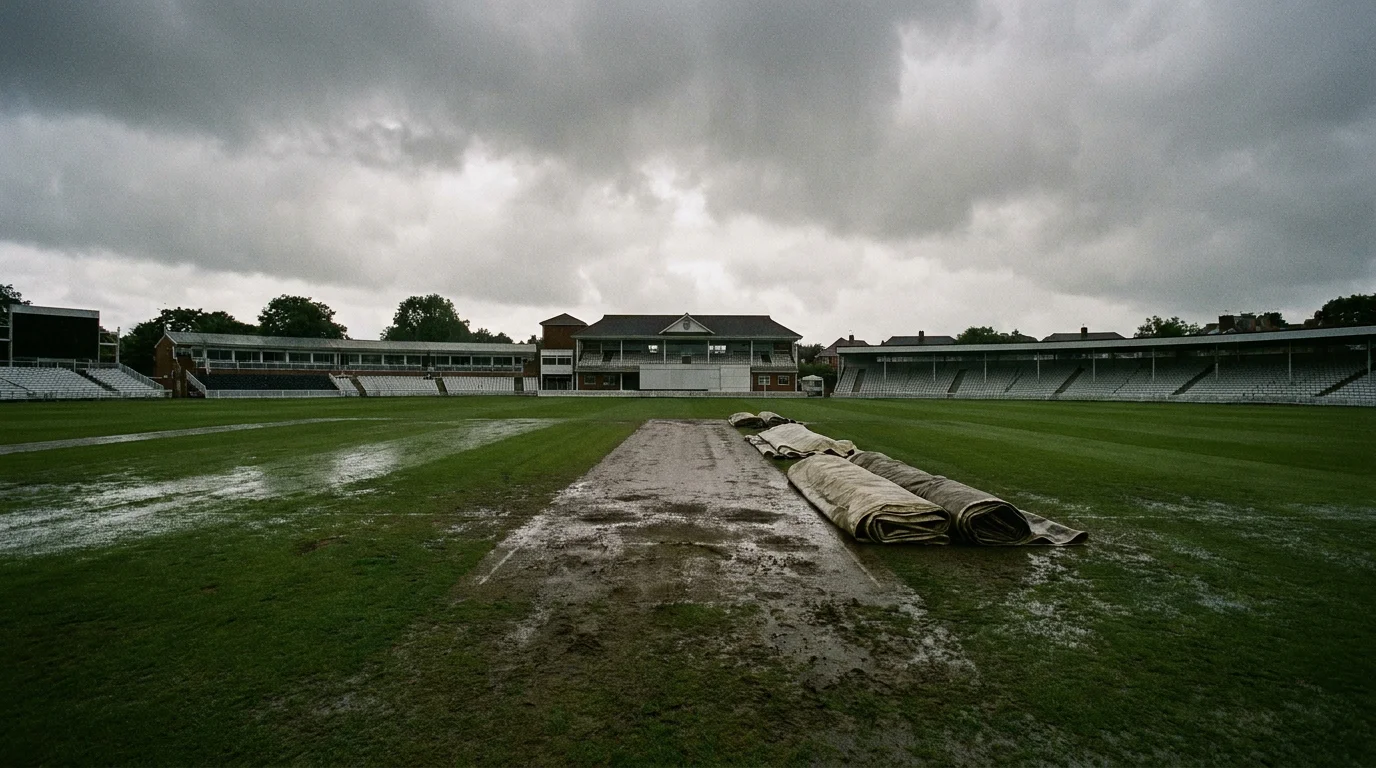
Weather works on cricket in two ways. It changes how the ball behaves, with overcast skies often helping swing bowling, and it can shorten or end a match entirely. When rain costs overs in a limited-overs game, the target is recalculated by a mathematical method, which can flip the advantage between sides in a single shower. In the longer format, a forecast of lost time makes the draw a far more likely outcome, which is exactly the trap that cost me my very first bet.
The practical upshot is that two pieces of homework belong in every serious cricket bet: the pitch report and the forecast. The pitch report, usually delivered before play, tells you what the groundstaff have produced and how it is expected to behave. The forecast tells you whether the full match is even likely to happen and which way the conditions lean. A punter who reads both and thinks through their interaction is operating with information the casual money simply ignores.
I will not pretend you can become a pitch expert from one section of a guide; reading surfaces well takes seasons of watching. But you can start with a simple discipline. Before you back a side, ask what the surface favours and whether the weather supports or undermines that. If a green seamer-friendly pitch meets an overcast sky and you are backing a team of batsmen against a strong seam attack, the market has almost certainly already moved against you, and a price that looked generous an hour ago may now be a trap. Conditions are the homework most people skip, which is precisely why doing it pays.
How Big the British Betting World Actually Is
When I tell people the scale of the numbers behind a quiet midweek bet, they tend not to believe me. We picture betting as a personal, almost private act, a tenner here and there. Step back and it is one of the largest consumer industries in the country, with the cricket you are betting on sitting inside a machine of genuinely enormous size.
Start with the sports betting market specifically. At the start of 2026, the UK sports betting market was generating around 2.48 billion pounds, roughly 3.3 billion dollars, in gross gambling yield each year. Gross gambling yield, or GGY, is the figure that matters: it is what operators keep after paying out winnings, the industry's true revenue, and it is the number regulators and analysts actually track rather than the headline turnover that gets thrown around.
2.48 billion pounds
Annual gross gambling yield of the UK sports betting market at the start of 2026.
Over 50 percent
Share of UK betting search clicks captured by just two operators in early 2026.
5,782
Licensed betting shops in Britain as of September 2025, out of 8,254 licensed gambling premises.
Two features of this market are worth your attention as a bettor, because they shape the prices you see. The first is concentration. By early 2026, two operators between them captured more than half of all UK betting search clicks. That tells you the market is dominated by a small number of very large brands, which has consequences for how competitive the odds are: in the most popular markets the big players price tightly against each other, while smaller or more niche markets can show wider variation.
The second feature is physical reach. As of September 2025, Britain had 8,254 licensed gambling premises, of which 5,782 were betting shops. The high street betting shop is not dead, even in an era when most cricket betting happens on a phone, and that physical presence is part of why the fractional odds format remains so embedded in British betting culture while the online world drifts towards decimals.
Around 22.5 million adults in Britain place a bet each month. That is roughly two in five of the adult population, a reminder that betting is firmly mainstream behaviour rather than a fringe activity.
Where does cricket sit inside all this? It is a meaningful and growing slice rather than the dominant one. Betting is the third most popular gambling activity in Britain after lotteries and scratchcards, and within sports betting the bulk of money has traditionally flowed to football and horseracing. But the picture is shifting. The regulator has explicitly noted operators reporting growth in sports beyond those staples, cricket included, and the global cricket segment is forecast as the fastest-growing part of the wider market. That is the structural tailwind behind everything in this guide, and it is why a sport that was once a niche on the British coupon now commands market menus that rival the biggest fixtures.
I am keeping the headline numbers here and pointing you onward for the detail, because the full breakdown of GGY, where cricket fits and how operator concentration plays out deserves its own treatment. But the takeaway for a bettor is simple: you are operating inside a huge, professionalised, heavily capitalised market. The odds you face were set by well-resourced operations, not amateurs, and respecting that is the starting point for taking any of this seriously.

The Rules That Hold It All Together
People ask me whether cricket betting is "allowed" in the UK as if it were a grey area. It is not remotely grey. Betting on cricket is fully legal in Britain provided you are eighteen or over and the operator holds a licence from the Gambling Commission. The interesting part is not whether it is legal but how tightly the framework around it has been redrawn in the past couple of years, because that reshaping touches every bettor whether they notice it or not.
The licence is the foundation. A Gambling Commission licence means the operator is bound by rules on fairness, on how it handles your money, on advertising, and on protecting players. That is what separates a regulated bookmaker from an offshore site that might take your stake and vanish. When you see a market priced and settled cleanly, that reliability is the licence working in the background. The recent wave of reform has built on that foundation rather than replacing it, tightening the protections and changing the economics of the industry.
Three reforms define the current landscape. New stake limits on online slots took effect in 2025, capping spins at five pounds for those aged twenty-five and over and two pounds for eighteen to twenty-four year olds. A statutory levy on operators came into force on 6 April 2025, requiring the industry to fund treatment, prevention and research, with the proceeds split roughly half to treatment, three-tenths to prevention and the remainder to research. And from April 2026, remote gaming duty rises to 40 percent. These do not all target cricket betting directly, but together they reshape the cost base and conduct of every licensed operator you bet with.
It is worth being precise about why these matter to you even when they seem aimed elsewhere. The slot stake limits are not about cricket, but they signal the regulator's appetite for direct intervention in product design, which is new. The statutory levy is the headline change: for the first time, the gambling industry is mandated to pay for the harm associated with it, with the money channelled into treatment, prevention and research rather than left to voluntary contributions. And the duty rise feeds straight into operator margins, which over time can influence the prices and promotions you are offered.
The enforcement side has teeth too. The regulator has been active against the illegal market, issuing cease-and-desist notices, geo-blocking sites and stripping out tens of thousands of URLs belonging to unlicensed operators. That matters because the single most important protective decision you make as a bettor is sticking to licensed operators. An unlicensed site offers you no recourse if it refuses to pay, no protection for your funds, and no guarantee the markets are fair.
This is a genuinely intricate area, and the distinction between what is legal, what is newly regulated and what the reforms actually change in practice deserves more room than an overview allows. I have set the whole thing out, including how to spot an unlicensed site and exactly what the 2025 reforms did and did not do, in a dedicated guide on whether cricket betting is legal in the UK and how the rules work. For now, carry the essentials: legal if you are over eighteen and the operator is licensed, increasingly tightly regulated, and built around a system that protects you only as long as you stay inside it.

Whether the Game You Are Betting On Is Real
Every cricket bettor eventually confronts an uncomfortable question: how do I know the match isn't fixed? It is a fair worry. Cricket has a longer and more public history of corruption scandals than most sports, and the format that makes it so rich to bet on, with its sessions and individual overs and discrete events, is the same feature that makes parts of it vulnerable to manipulation. Pretending otherwise would be dishonest. The reassuring truth is that the scale of clean cricket dwarfs the scale of the rotten, and the systems watching over it have never been more capable.
The connection between betting and corruption is not incidental; it is the entire mechanism. As the sport's anti-corruption body puts it, advancing technology and growing popularity have driven a substantial increase in both the amount and the sophistication of betting on cricket matches, and that money is precisely what makes a fix worth attempting. Where there is profit to be made by knowing an outcome in advance, someone will try, which is why the monitoring infrastructure exists.
The monitoring is industrial in scale. In 2025, the major integrity monitor tracked more than a million sporting events across seventy sports and flagged 1,116 as suspicious, slightly fewer than the year before. Within that, cricket accounted for 59 suspicious matches, a noticeable rise. Read carefully, those numbers are reassuring rather than alarming: across all sport, more than 99.5 percent of events were monitored free from any suspicion of manipulation.
That 99.5 percent figure is the one to anchor on. The vast majority of cricket you watch and bet on is exactly what it appears to be: a genuine contest decided on the field. The suspicious matches are real and the rise in cricket's count deserves attention, but they are a tiny fraction of the whole, and they are being caught precisely because the surveillance works. The sport's anti-corruption unit has operated since 2000, and its global code, updated in mid-2024, covers international and domestic cricket alike.
For you as a bettor, the practical implications are narrow but worth holding. First, the markets most associated with manipulation are the granular in-game ones, sessions and individual passages of play, rather than the headline result, so a little extra caution there is sensible. Second, betting through a licensed operator means your activity sits inside a system that cooperates with the integrity bodies, which is one more reason to stay on the regulated side of the line. And third, if a market or a price ever looks too good in a context that makes no sense, the healthiest instinct is suspicion rather than greed. The overwhelming majority of cricket is clean. Your job is simply not to be the rare exception who walks into the small minority that is not.

Keeping It a Hobby, Not a Hole
I will be blunt, because this is the part of the guide that actually matters more than any odds calculation: the goal is to keep betting a small, enjoyable part of following cricket, and the moment it stops being that, the maths becomes irrelevant. I have watched sharp, knowledgeable people lose far more than they could afford, not because they were bad at reading a match but because they never set a limit and stuck to it. Skill at picking winners is no protection against the absence of discipline.
The regulatory framework now takes this seriously in a way it once did not. The statutory levy that came into force in 2025 channels industry money into treatment, prevention and research, with roughly half earmarked for treatment under the health service, the first time operators have been mandated to fund the harm associated with their products rather than choosing to. That shift matters because it acknowledges, at the level of law, that gambling carries real risk. The most striking official line on product risk came from a government minister who described online slots as the highest-risk gambling product, with the highest rate of binge play and the highest average losses of any online product. Cricket betting is not slots, but the underlying lesson, that some ways of betting are far more dangerous than others, applies across the board.
Run through this before every bet
- I have set a budget for this and I am inside it.
- This is money I can afford to lose entirely.
- I am betting because I want to, not to chase back a loss.
- The operator is licensed by the Gambling Commission.
- I understand exactly how this market settles.
- I am sober and clear-headed, not betting on impulse.
Beyond the single-bet check, a few habits separate sustainable betting from the kind that quietly spirals. The deposit limits, time-outs and self-exclusion tools that every licensed operator must offer are not admissions of weakness; they are the equivalent of a speed limiter, and using them proactively is a sign of a bettor who intends to still be enjoying this in ten years.
Do
- Set deposit and loss limits before you start, not after.
- Treat your budget as the price of entertainment, already spent.
- Take breaks, especially after a big win or a bad run.
- Stick to operators licensed by the Gambling Commission.
Don't
- Chase losses by betting bigger to win it back.
- Bet money earmarked for bills, rent or essentials.
- Bet to escape stress or low mood.
- Hide your betting from people close to you.
If betting has stopped feeling like a hobby, free, confidential support is available across the UK, and reaching for it early is the strongest move a bettor can make. The whole point of staying inside the regulated system, setting limits and running the checklist is to make sure the worst case never arrives. Win or lose, the cricket should still be the thing you came for.

Questions Cricket Bettors Keep Asking Me
After seven years of fielding the same handful of questions from friends, readers and people who spot me studying a market board in a pub, these are the ones that come up most. The answers here are the short version; the dedicated guides go deeper.
How does cricket betting work for a complete beginner?
You open an account with an operator licensed by the Gambling Commission, choose a market such as the match winner, decide your stake, and place the bet at the odds shown. If your prediction is correct, you collect your stake plus winnings calculated from those odds. The mechanics are straightforward; the skill is in choosing which of the many markets you actually understand well enough to bet on. Start small, stick to simple result markets, and learn how odds convert to probability before you branch out.
Which cricket formats can you bet on in the UK?
All of them. You can bet on five-day Test matches, fifty-over one-day internationals, the twenty-over game, the hundred-ball competition and the domestic four-day County Championship, along with the various franchise and international tournaments. Each format behaves differently: Tests bring the draw and the conditions into play, while the short formats are sprints dominated by big overs and totals. The format you choose should suit how you like to bet, not just which teams you follow.
What does a UKGC licence mean for a punter?
It means the operator is bound by rules on fair play, handling your money safely, honest advertising and protecting players, and that you have recourse if something goes wrong. A licensed operator settles markets according to published rules and contributes to the systems that watch over the industry. An unlicensed site offers none of that. Checking for a Gambling Commission licence is the single most important protective step you take, because everything else, fair odds, clean settlement, the ability to complain, depends on it.
Is online cricket betting safe and regulated in Britain?
Yes, provided you use a licensed operator and are eighteen or over. Online cricket betting in Britain sits inside one of the more heavily regulated frameworks in the world, recently tightened further by the 2025 reforms, including a statutory levy funding treatment and research. The regulator actively pursues illegal sites, blocking and removing tens of thousands of unlicensed URLs. The safety is real, but it only protects you while you stay on the licensed side of the line.
How much do Britons actually bet on sport?
A lot. Around 22.5 million adults place a bet each month, and the UK sports betting market generates roughly 2.48 billion pounds in gross gambling yield a year. Betting is the third most popular gambling activity after lotteries and scratchcards, with around ten percent of adults betting in any four-week period. There is a clear gender split, with 16 percent of men reporting a bet in the last four weeks against four percent of women. Betting is firmly mainstream, not a fringe pursuit.
What is the single biggest beginner mistake in cricket betting?
Ignoring the draw and the conditions. Newcomers back a favourite in a Test, watch the team dominate, and then lose when rain or a stubborn rearguard produces a draw, an outcome that simply does not exist in the same way in most sports. Close behind is carrying a short-format instinct into a long-format bet, or vice versa. Read the format, read the pitch, read the forecast, and never assume cricket behaves like the other sports on the coupon.